I stumbled across a Reddit post a few days ago, where a user was asking for troubleshooting advice on a restraint issue his park was encountering. This wasn't an enthusiast asking about how something worked, nor somebody explaining an interesting story that happened. It was an actual park employee turning to an online discussion board looking for answers.
THIS IS NOT OKAY!
Disclaimers:
1. It's not the worst thing in the world for somebody to try and seek help, rather than "wing it" on something as safety critical as a restraint component. However, there are better avenues for this.
2. While I cannot find any specific info about the ride or park that this issue is taking place at, what does it say about their operation and maintenance if this is the way they are going about seeking answers? Is there really not anybody on-site that can solve this problem?
3. There isn't a single rides maintenance technician who knows everything. However, the fact that this technician does not seem to understand the basic troubleshooting process as well as the absolute necessity to keep the restraint out of service until it is corrected is astonishing.
Here's the scenario: The user is asking about why a Class II restraint is having an issue where it is coming open on certain ride cycles. It seems to be an older ride, where information is harder to come by, and the manufacturer may not be around anymore. For those unaware, a Class II restraint is in reference to ASTM Standards F2291 for the Design of Amusement Rides and Devices.
Class II restraints have the following qualities:
- May be individual or a collective device for more than one patron
- Final latching position may be fixed or variable
- The patron or operator may latch the restraint
- Patron or operator may unlatch the restraint
- No external indication (restraint monitoring) is required
- The restraint may be manually or automatically opened and closed
- Redundancy is not required
Class II restraints are generally reserved for more tame rides, such as flat rides, family coasters such as mine trains, etc. G-force limits are between +0.2g to -0.7g for acceleration, and no less than +0.2g for positive g-force (i.e. no zero gravity or ejector moments). This means that the most "intense" portion of the ride may be a sudden stop from a braking system. This also is assuming that the ride is not "grandfathered" in and is an older ride that features a Class II restraint, when in reality if it were designed today may have required a more stringent class.
Credit: User
Looking at the schematic posted, it shows two individual lap bars, each coupled to an individual hydraulic cylinder. The user also describes the system to operate at 24VDC. Both the use of hydraulic cylinders as well as 24VDC in a PLC-based system are likely modifications or upgrades if this is truly an older attraction. PLC control was not prominently nor widely used until (*I believe*) at least the 1980s. Hydraulic cylinders for restraints didn't become common until the late-1990s.
Intermittently during operation, the restraint has opened twice. After the first instance, the maintenance team decided to bleed the hydraulic cylinder and replace the oil. Upon occurring again, the restraint has been subjected to a creep test, which it allegedly has passed. Since then, the seat has been taken out of service, and the cylinder is being returned to its manufacturer for examination.
The user asks some questions which we will explore:
Could this be caused by internal valve leakage or a sticking spool that doesn’t fully return to the closed position?
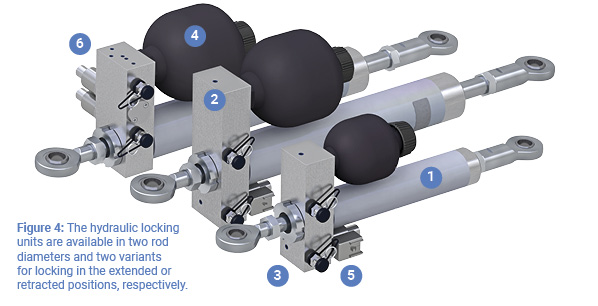
Absolutely, degradation of the valve spool itself, the seals or O-rings, a weak spring, and contamination in the valve causing it not to fully close (foreign particles or moisture), among other issues, could cause this to happen. Hydraulic locking units (HLU) usually included a directional spool valve operated by a solenoid, and a check valve. When the cylinder is deenergized, the check valve allows for fluid to travel one way, i.e. pushing the restraint down, but disallows movement in the up direction. When energized, the spool valve shifts, allowing for the hydraulic fluid to flow, and the restraint can open.
There's a couple of different styles of this. Most cylinders have a pressurized accumulator that keeps a charge pressure on the valve, as well as returning the restraint to the open position when energized. Oil is only present on one side of the piston. At least from the rough diagram, it seems that this is a sort of "closed loop" system. Oil can travel on both sides of the piston, separated by valving. Sometimes, gas shocks are used in place of an accumulator. I've worked on these style units on S&S towers.
I've noticed that the closed systems are more prone to trapping air in them through the rod end seals. We had a procedure direct from S&S to "re-charge" the hydraulic units with a special pump. You followed a procedure where you connected hoses to quick-connect fittings on the restraint valve, cycling it open and closed to move the fluid. The pump had an aerator which removed excess air from the cylinder. If we had a problem from restraint creep or if the restraint felt weak, this was the first (and really only) step to resolve it. If the problem continued or arose shortly again, we had to take the unit out of service and replace it. Part of the annual rehab for the towers included sending the cylinders to S&S for inspection, repair, and testing in order to remove liability on our part. It sounds like whoever this manufacturer is has a similar procedure.
2. Has anyone seen solenoid valves partially energize due to wiring issues, induced voltage, or residual magnetism?
No, I cannot say that I have heard of this. Once the circuit is broken and current stops, the magnetic field induced by the coil stops. If this weren't the case, hydraulic valves wouldn't be designed the way that they are. Unless there is something weirdly designed in the circuit, such as a capacitor draining a charge momentarily, I don't see a way for this to be possible. When trains leave the electrical contacts in the station area, it should be electrically dead unless there is on-board audio, lighting, or other battery powered device.
3. Could extended lap bar open time during loading/unloading affect spool centering or cause delayed closure?
Again, this should not be the case. If the system is working as designed, as soon as that open signal is removed, the restraints should immediately lock with no delay. If there is a delay, it is indicative of an issue with the valving in the restraint. There are rides that have timers that will automatically lock the restraints after a specified time, and there's some that operate with an open or closed button/switch. Either way, open should immediately open and vice versa. Going back to the S&S tower, the operators were supposed to lock the restraints at the end of the day, and sometimes they left them unlocked, meaning the coils were active all night. Even in the morning, switching the seats to locked should be an immediate result.
4. Any experience with temperature effects (cooler night operation) on older hydraulic seals or valve behavior?
Yes. Colder oil is more viscous (thicker). Certain elements of hydraulic systems will indeed work harder or have slightly delayed response due to thick oil. Going on a bit of a tangent here, but many hydraulic-driven rides actually rotate faster when the oil is cold because with it being thicker, it sort of has more "pushing force" when going through motors and such. There's also an issue when hydraulic fluid gets too hot, losing much viscosity and not being able to get rides to minimum speed in some cases. If we came in to a restraint that had opened overnight when it was cold out, it was a very good indicator that the valve was likely worn, and it was time to swap the locking unit.
5. What additional tests would you recommend beyond ball creep testing to confirm the root cause?
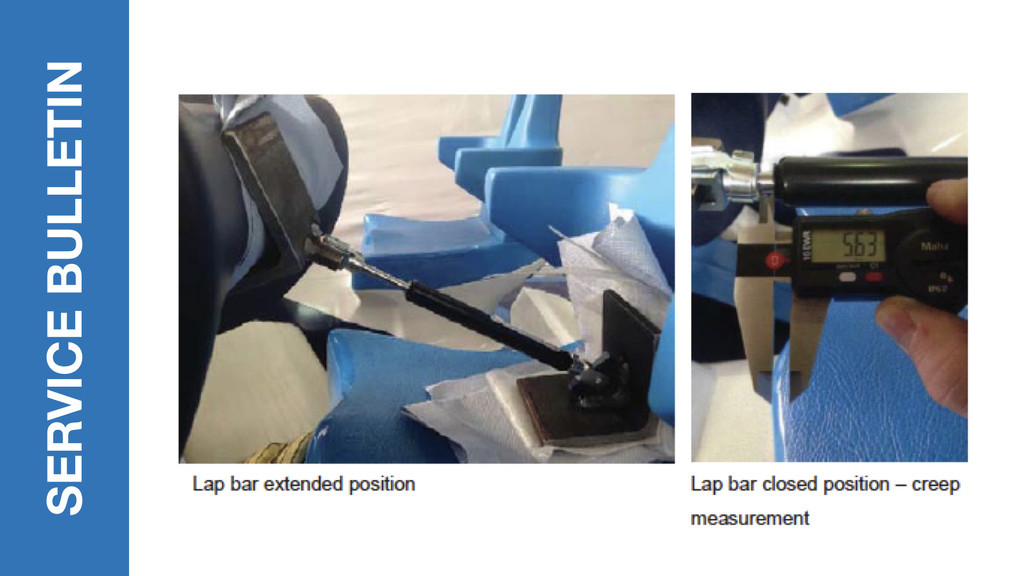
Creep tests involve the use of a special jig that both creates a force against the restraint, putting pressure on the hydraulic components, and a device to measure distance "creeped" over time. Usually, a manufacturer will specify a set force, time, and maximum allowable distance for the restraint to open during the test. If the restraint opens further than that distance during the test, the HLU is considered to fail and should be removed from service.
This test evaluates wear and function of spool valves, check valves, seals, piston rings, etc. Oil will leak past or "blow by" worn items, resulting in the restraint opening. It is a good indicator of these items without having to dismantle and inspect all internals of the restraint. Oftentimes, parks are not certified to or simply do not want to take the liability of servicing these items. I have heard of parks sending technicians to get certified by the manufacturer to work on restraint cylinders, but it is uncommon. For us, the options were to send out a faulty restraint cylinder or retire it from service completely.
If the option is there, the valves could be swapped, and the restraint could be tested again. Other than bench testing the cylinder, there is not much of an option here other than a full teardown and inspection. It's hard at times to justify throwing parts at something and not following through on the troubleshooting aspect of the job, but restraint units are a tricky subject, and the most critical safety component of a ride.
Source: Fluid Power Journal
The absolute best course of action here is to remove/replace the HLU and consult with the manufacturer or an expert in such devices (which has been done since the initial post). I have not been able to pinpoint the exact ride that this has come off, but I feel like I have gotten close. According to the poster, the ride is at least 25 years old, operates in a warm climate for January, and takes two laps over a 360m track. I have a hunch that the product in question is a Zierer Tivoli coaster (think Harley Quinn at Six Flags Great Adventure) that the trains have been modified/retrofitted by another company over time.
Zierer has discontinued the Tivoli model, focusing on their newer Force coasters. This would explain the "lack of OEM support" discussed in the post. Another comment stated that the restraint has been "shipped to its manufacturer in the UK" for analysis. The UK is not well known for roller coaster manufacturers, nor for being a major exporter of hydraulic cylinders for amusement rides. A company such as Amusement Technical may have been tasked at some point to update the trains or restraints for the longevity of the ride. Once you go to a third party for a retrofit, the original manufacturer will indeed wash their hands clean of the attraction, regardless of if they still manufacture the product or not. Again, speculation, but I think that's the most likely scenario.
Going back to the original point discussed, the internet is not the place to be making decisions on fixing a restraint on an amusement ride. It's a great place to search for answers from trusted sources, as well as learn about different areas and means or troubleshooting a system. How dangerous would it be for someone who jokingly (or not) gave out misleading information to this user, leading to an injury or fatality on the attraction? This is why you don't see a lot of technical information about amusement rides on the internet. Sure, you'll see tidbits here and there of behind-the-scenes areas or learn about how things work, but the nitty-gritty of the industry is a well-kept secret. This post may seem quite revealing about hydraulic restraints, but I am simply explaining the basic functions of them, as well as some troubleshooting. Nowhere in here are full schematics, torque values, assemblies, maintenance instructions, etc. Information like that falling into the wrong hands is extremely unsafe.
I feel bad for the poster, in the sense that their park lacks the knowledge to get past this situation, which is a fundamental of ride maintenance. It just also scares me that in the trades world, which is aging faster than retirees are being replaced with young, competent help, knowledge is possibly being lost along the way, and apprentices are relying on social media or AI to help them with situations. Training and succession preparation are crucial to ensure the industry upkeeps its high safety standards.




Comments
Post a Comment