Flying Saucers, Flying Tires, and Hoverboards: The Evolution of Disney's Failed Concept
It’s the 1960s. Futuristic themes are incorporated into the American lifestyle, with advancements in technology, and the thought of what tomorrow will bring. Shows like The Jetsons (1962) as well as many others are bringing forward the idea of “Space Age.” There are also countless cheesy horror B-movies being released across the country and shown in drive-ins to countless Americans. Sci-fi themes such as UFOs and other space monsters become popular topics.
One attraction explored by Walt Disney was that of a hovercraft style vehicle. A German salesman had delivered a hovercraft to him, complete with rotating fans and the ability to levitate above the ground. This idea was actually considered for a ride system at one point to replace the problematic Phantom Boats in Tomorrowland. However, the hovercrafts were very noisy, and it was viewed as too dangerous to have guests sitting near high speed rotating blades.
Another possibility was explored with a bumper boat system. A known technology at the time, this ride system combined classic bumper cars with floating circular boats. Several companies had produced them as early as the 1930s, and the ride system was popular in the Midwest at the time. Bob Gurr was assigned to investigate this style attraction, which was seen as too slow loading and common to be offered at Disneyland. In fact this concept was among the several projects planned but cancelled before the opening of Disneyland in 1955. Named “Duck Bumps,” guests would ride on circular boats with a duck head on the front through a pond with the ability to bump into one another.
Walt took the idea to his trusted ride manufacturers, Karl Bacon and Ed Morgan from Arrow Development to fuse the attractions together to create a completely new idea. With the help of Bob Gurr’s vehicle design, they had created a working prototype at their facility. In fact, the ride operated much like a large air hockey table.
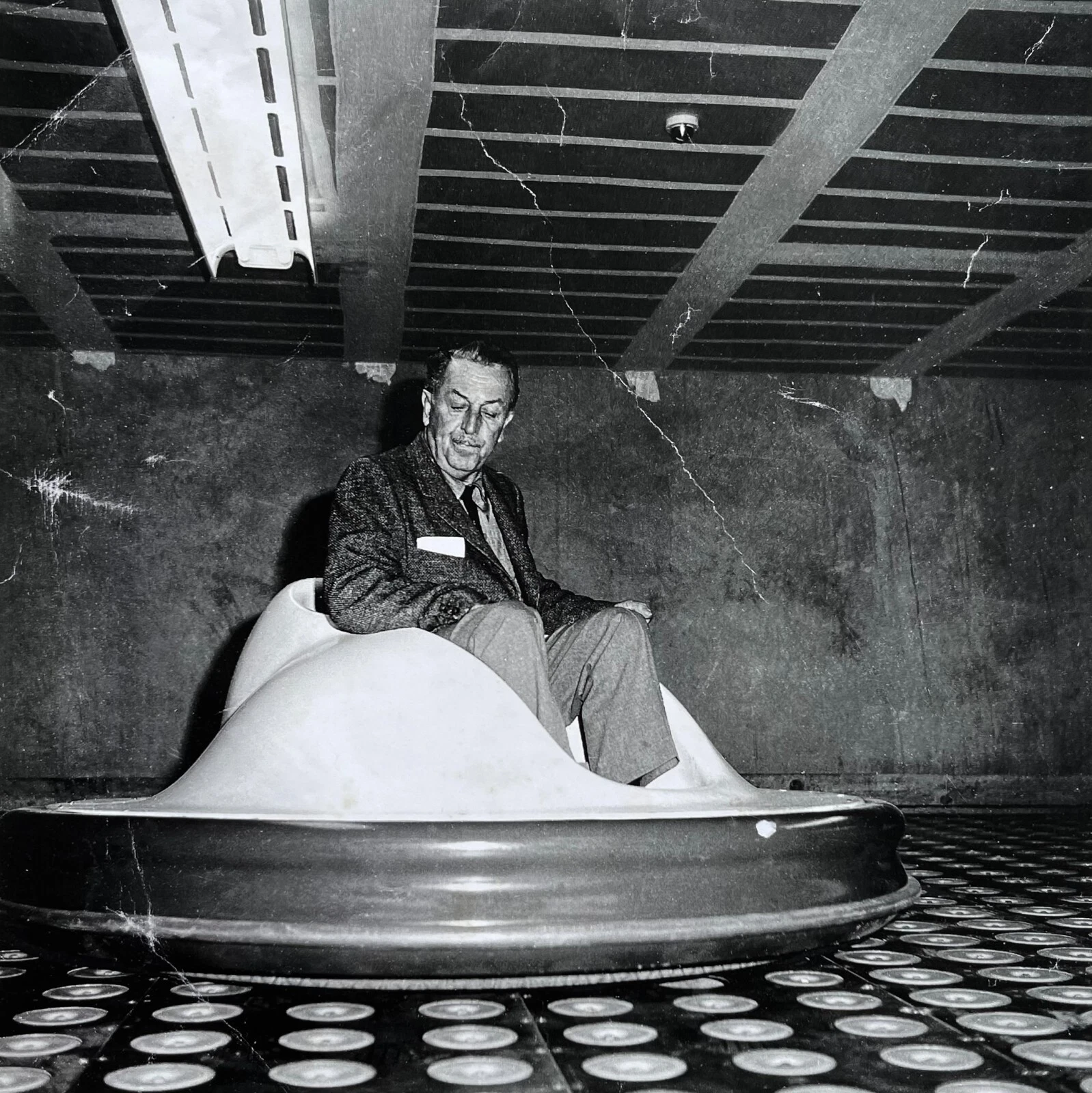
The idea involves a large air chamber powered by blower fans. With the help of actuating valves, each vehicle would be lifted around 2-8 inches above the ride platform and levitate. To steer the car, guests would simply lean to whichever way they wanted to go, and the saucer would travel in that direction. This entire effect relied on pressure differentials to both move the vehicle, and open/close the valves.
Since guests could not step on the air valves or ride platform, a large arm would sweep the saucers into a loading bay where guests could safely load onto the attraction. This sweeping arm also served the purpose of allowing for two sets of saucers to operate at once. While one set of saucers were swept up to end the ride cycle, another batch was freed up to levitate around the ride area. This concept is known as “batch loading”, and with a big enough arena, four separate sets of saucers could operate at once. Bill Martin developed this idea from one of the Bumper Boat style rides at Riverside Park in Chicago. A large bridge would push a set of boats to one side of the pond, allowing for loading and unloading. This also expedited the process of corralling stray riders once the determined ride time ended.
Walt Disney rode the scaled down prototype at the Arrow facility, and was sold on the idea. At this point, construction began on the complex attraction. A 16,000 square foot area was required not only for a 9-foot deep “plenum chamber” that held the air for the platform, but also a series of complicated air ducts. Thousands of actuator valves were required for the production of the ride, each one supporting a flap disc only a few inches wide. Roger Broggie had to come up with actuators for each air valve. A surplus of actuators had become available from a project involving the second stage of a Jupiter missile at a cheap cost. Needing to fulfill the massive requirement, Disney acquired these second-hand parts, but found that they had almost immediately failed upon installation. Wondering what the actuators had been used for, the supplier was surprised at their failure, since they had been used for a total of five seconds on the missile for pitch control, then removed from service.
Once the actuator issues were resolved, testing of the 64 flying saucers began. A rubber skirt surrounded each single rider saucer to absorb impacts from bumping. The shape of the saucer allowed for an air chamber to form under the vehicles’ seats. Low pressure air in the plenum chamber closed each valve individually until the saucers rode over the valve. Down pressure caused by the levitating saucers forced each valve open as it rode over it, providing the air cushion for levitation. As the saucers moved around the platform, the valves opened and closed based on the position and pressure differential of the vehicle. When a rider tilted a certain direction, the pressure formed a sort of “ramp” shape under the vehicle, propelling it towards the leaning direction. Simple physics and aerodynamics control each individual vehicle and the valves underneath.

However, issues persisted during the testing phases. It was common for air valves to break, leading them to be stuck open or closed, affecting the ride performance. Technicians were constantly repairing the ride. Flying Saucers actually became the first Disneyland ride to open behind schedule, on August 6, 1961. Much like with all attractions at the time, there was an opening ceremony to accompany the attraction. Disney invited some of the nation’s finest jet pilots at the time, as well as their children to attend the attraction’s opening. Also on hand were Pluto the dog, and “Space Man and Space Girl,” two walk-around characters from Tomorrowland.
Guests loved the attraction, but there was also some difficulty involved with riders learning how to steer the vehicles. Although there were informational signs in the queue lines, small riders would often just hop up and down in one place, while larger riders had difficulty getting the saucers to move. At one point, beach balls were added to the ride area for guests to play with, adding some excitement to the cumbersome vehicles. These were eventually removed as it was an added liability for injuries to occur.
Problems continued with the mechanical systems of the ride. Besides sticking valves, sometimes the ride would lose enough of the low pressure in the plenum chamber that all the valves would open at once, causing a sonic boom and all of the ride vehicles falling to the ground at once. It took a long time for the blower fans to recharge enough air pressure to begin operation again. Bob Gurr credits this to “undamped divergent oscillation”. Because the plenum chamber was so much deeper at Disneyland than it was on the prototype at Arrow’s facility, the internal low pressure air had a tendency to move around too much, causing an imbalance of pressure. Once the oscillation grew too high, the air valves would not operate correctly, allowing too much pressure to be lost to the ride platform, and not enough supply pressure for the vehicles.
Some of these issues could have been resolved by redesigning the plenum chamber, as well as the addition of sensors and feedback to a processor, which could have controlled each valve individually. This would have proven to be more reliable, as the simple mechanical system had too many reliability issues. At the time, this technology was either not available, or too expensive to install.
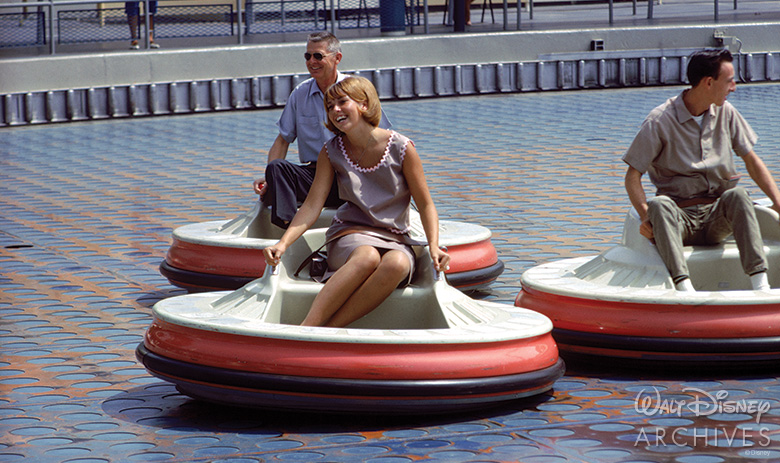
Because of the low capacity and mechanical issues, not many guests got to experience the attraction on a daily basis, which is the perfect recipe for the removal of an attraction. The repairs were timely and costly, leading to much downtime. Possibly the final nail in the coffin is when one day, Walt Disney who was unhappy with the ride’s performance went out onto the platform to investigate the problematic air valves. After stepping backwards into an open valve, he fell over and required medical attention.
The 1967 reopening of Tomorrowland did not see the saucers return, having only survived around 5 years of service. Being quietly retired, it is one of the shortest tenured attractions in the park’s history. The area was redeveloped into Tomorrowland Stage, which is roughly where part of the Space Mountain show building exists today.
Lessons Learned and the Future of the Concept
Walt Disney desired an attraction where there was no track, no motors, and no predictable outcome every cycle. He wanted a concept where the guests had control (or at least perceived control). Autopia, in its earliest iteration, attempted this by giving guests control of driving their own vehicles on Disney’s freeway of tomorrow. However, too much control can also be a bad thing. Guests used the Mark I Autopia vehicles as bumper cars and broke several rules of the road over time.
While Flying Saucers is an attraction where collisions are not only expected, but encouraged, human weight was too unpredictable of a variable to control. Some small children weighed 50 lbs. or less, while some grown adults could exceed 250 lbs. While this is a range in the magnitude of around 5 times, when fluid power comes into play, lifting force is affected proportionally by pressure. Using the same saucer surface area and pressure of the plenum chamber, lifting force may be multiplied several times more than the weight.
The ride system was not inherently easy to control for a rider who has never boarded the saucers before. Some riders simply could not get the vehicle to move much, and others could not control the bouncing or excessive acceleration easily. Allegedly, this led to some injuries over the years, with high-speed saucers crashing quite harshly into stationary ones.
We have covered the issues with the finicky air valves, and how they could have been improved with a modern control system that implemented feedback. In addition to maintenance costs, the actual operation of the ride was not cheap either. It required 300,000 cfm of air supply to fill the arena’s plenum chamber. To put this in perspective, I own a fairly sizable air compressor that I use to run all of my air-powered tools when I do projects at home. It’s only rated around 5-6 cfm. In fact, some of the larger air compressors I have dealt with, the size of a pickup truck and could run high air-consumption rides with an S&S tower complex can only put out a fraction of what was required for the saucers. This must have cost a small fortune to run all day long.
I was surprised to learn that the saucers were the only ride in Disney history that was designed to hold one rider per vehicle. This is so unconventional for Disney who tries to maximize capacity for their popular rides. However, some of these talking points would be considered for the second iteration of the attraction.
In 2012, Disney’s California Adventure opened Luigi’s Flying Tires, a spiritual successor to the original saucers. With 50 years of technological development since the original attraction debuted, many issues with valving and the operation were resolved. The saucers, now large truck tires, were designed to be larger and hold two adult guests at a time. Imagineers had hoped that by adding size and weight to the tires that it would have less of an effect on each rider’s weight, making it negligible at that point. Although the vehicle’s capacity was increased, only one batch operated at a time, making loading even slower. Guests could now walk on the ride platform to board as opposed to the mechanical arm “batch load” method due to redesigned valves.
Bob Iger had ridden the attraction prior to the Cars Land opening, and was quite disappointed with the $100 million attraction. He has asked imagineers to find a way to make the vehicles move faster, increase the ride time, and add music to the experience. Each cycle was increased from 90 seconds to 2:15, with hopes of the riders having more time to figure out how to maneuver the vehicles. However, this came at the cost of capacity, which was limited to only 600 riders per hour on a good day. An eight song soundtrack was recorded for the attraction, and bright beach balls were purchased. This added an additional million dollars to the budget.

Feedback was mixed; some guests really enjoyed the ride, but many found the vehicles too cumbersome to move at their increased size and weight. Beach balls debuted in the ride arena, but were removed after several complaints. Too many guests were being hit by rowdy teenagers, but the balls also led to a distraction during the loading process.
From a reliability perspective, the attraction was the complete opposite of the original saucers. It had one of the best uptime percentages of almost all attractions at the Disneyland Resort. However, between the high energy costs required to run the ride, and lawsuits piling up from injuries involved on the vehicles, it became quite difficult to justify keeping the attraction around. Typically, high maintenance costs coupled with low ridership will cause attraction removal. For Luigi’s Flying Tires, poor feedback, the worries of constant liability, and the high volume of pressurized air required at all times, it forced Disney’s hand. After not even three years of operation, the attraction was closed on February 17, 2015. It would be replaced by Luigi’s Rollickin’ Roadsters, a spinning trackless ride.


Comments
Post a Comment